Bedrock AgentCore Adds Code-Based Evaluators for Production Agents
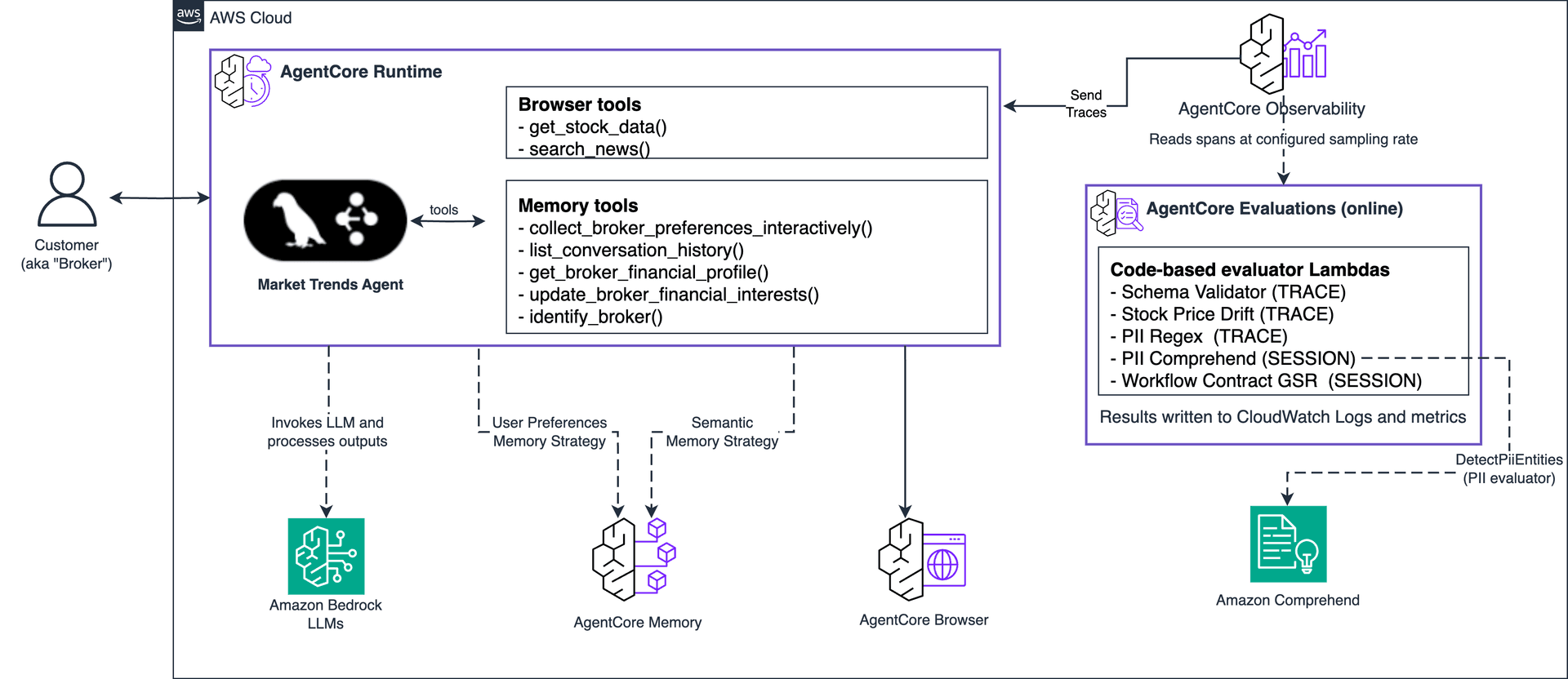
Amazon Bedrock AgentCore now supports custom code-based evaluators built on AWS Lambda, allowing developers to assess agentic applications using deterministic logic rather than LLM-as-a-Judge checks. The feature targets production-grade quality assurance for agents in regulated domains like financial services, where requirements include schema validation, numerical accuracy checks, workflow compliance, and PII detection. Code-based evaluators can run in on-demand evaluation workflows and online production monitoring, and can be combined with built-in LLM evaluators for comprehensive quality assessment.
Executive Summary
Amazon Bedrock AgentCore now supports custom code-based evaluators built on AWS Lambda, enabling developers to assess agentic applications using deterministic logic instead of relying solely on LLM-as-a-Judge evaluations. This feature is particularly valuable for production environments in regulated industries, where evaluators can validate schema compliance, numerical accuracy, workflow adherence, and PII detection. Code-based evaluators can operate both in on-demand evaluation workflows and continuous production monitoring, and can be combined with built-in LLM evaluators for comprehensive quality assurance.
Key Takeaways
- Code-based evaluators provide deterministic, repeatable quality checks for agentic applications without the variability inherent in LLM-based judgments.
- Custom Lambda-based evaluators enable validation of specific requirements like schema correctness, numerical precision, and regulatory compliance in production agents.
- The feature supports both offline evaluation workflows and real-time production monitoring, making it suitable for continuous quality assurance across the agent lifecycle.
- Integration with built-in LLM evaluators allows teams to combine deterministic checks with semantic evaluation for comprehensive coverage of agent behavior.
- This capability directly addresses compliance and risk management needs in regulated sectors such as financial services, healthcare, and government.
Why It Matters
Production agentic systems in regulated industries require reliable quality assurance mechanisms beyond probabilistic LLM judgments, and code-based evaluators provide the deterministic, auditable validation necessary to meet compliance requirements and operational standards. By combining custom logic with LLM evaluators, organizations can significantly reduce risk, improve agent reliability, and demonstrate compliance in mission-critical deployments.
Deep Dive
The introduction of code-based evaluators in Bedrock AgentCore addresses a critical gap in agentic application quality assurance. While LLM-as-a-Judge approaches offer semantic understanding and flexibility, they introduce inherent variability and non-determinism that can be problematic in environments requiring audit trails, regulatory compliance, and numerical precision. Code-based evaluators, running on AWS Lambda, provide developers with the ability to encode specific business rules and validation logic that must be deterministically enforced regardless of model behavior or version changes.
The practical applications span multiple dimensions of agent evaluation. Schema validation ensures that agent outputs conform to expected data structures before downstream processing. Numerical accuracy checks become critical in financial applications where even small calculation errors can have significant consequences. Workflow compliance verification confirms that agents follow prescribed process sequences and decision paths, particularly important in healthcare and legal contexts. PII detection protects sensitive data from being exposed or logged inappropriately, directly supporting GDPR, HIPAA, and other regulatory frameworks.
The hybrid evaluation approach, combining code-based and LLM-based evaluators, creates a complementary quality framework. Deterministic evaluators handle well-defined, rule-based assessments where outcomes are black-and-white, while LLM evaluators assess nuanced aspects like response quality, relevance, and appropriateness. This separation of concerns allows teams to optimize each evaluation path for its specific strengths, reducing false positives from overly strict rule-based checks while preventing LLM drift from undermining critical compliance requirements.
Deployment flexibility represents another significant advantage. On-demand evaluation workflows support pre-production testing and iterative development, enabling teams to validate agents before deployment. Simultaneous support for online production monitoring means organizations can continuously track agent behavior against defined quality metrics in real time, triggering alerts or automatic remediation when code-based evaluators detect deviations. This dual capability supports both development rigor and operational resilience.
Expert Perspective
Industry practitioners recognize that agentic systems in regulated domains demand more than probabilistic quality metrics. A production-grade agent platform must provide deterministic validation mechanisms that create auditable records of compliance verification. Code-based evaluators represent a maturation of the agentic evaluation landscape, bridging the gap between powerful language models and the operational rigor required by financial institutions, healthcare providers, and government agencies. This feature positions Bedrock AgentCore as a platform designed not just for experimentation but for enterprise deployment where determinism and auditability are non-negotiable requirements.
What to Do Next
- Review your current agent quality assurance processes to identify validation requirements that demand deterministic logic rather than probabilistic LLM evaluation, such as regulatory compliance checks or numerical accuracy thresholds.
- Develop a library of Lambda-based evaluators that encode critical business rules and compliance requirements specific to your industry and use case, treating these as reusable quality components.
- Implement a hybrid evaluation strategy that delegates schema validation, numerical checks, and PII detection to code-based evaluators while using LLM evaluators for semantic quality assessment.
- Establish continuous production monitoring using code-based evaluators to detect agent drift or compliance violations in real time, with automatic alerting or remediation workflows for critical failures.
Our Briefing
Weekly signal. No noise. Built for founders, operators, and AI-curious professionals.
No spam. Unsubscribe any time.