AWS Automates Dashboard Updates with Multi-Agent AI
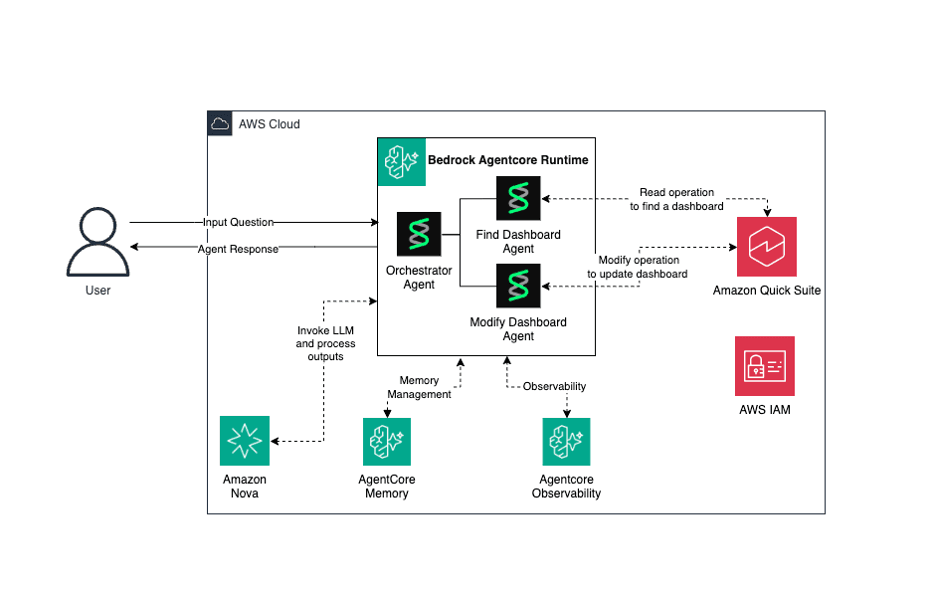
AWS has released a solution using Amazon Bedrock AgentCore and the Strands framework to automate dashboard modifications through natural language requests. The multi-agent architecture reduces dashboard update turnaround times from days to near-real-time by routing user queries to specialized agents that handle discovery, modification, and orchestration. The system maintains security controls and audit trails while enabling business analysts to bypass traditional IT request workflows.
Executive Summary
AWS has introduced an AI-powered automation solution leveraging Amazon Bedrock AgentCore and the Strands framework to enable natural language-driven dashboard updates through a multi-agent architecture. The system dramatically reduces modification turnaround times from days to near-real-time while maintaining security controls and audit trails, allowing business analysts to self-service dashboard changes without IT intermediaries.
Key Takeaways
- Multi-agent AI architecture routes specialized tasks (discovery, modification, orchestration) to dedicated agents, improving efficiency and reducing human bottlenecks in dashboard management workflows.
- Dashboard update cycles compress from days to near-real-time, enabling faster business decision-making and reducing the IT request backlog for routine analytics modifications.
- Natural language interfaces democratize dashboard access by allowing non-technical business analysts to make changes directly, bypassing traditional IT governance workflows while maintaining audit trails and security controls.
- The solution combines Amazon Bedrock's foundation models with AgentCore's agentic capabilities and Strands' orchestration framework, creating a production-ready architecture for enterprise automation use cases.
Why It Matters
This advancement addresses a persistent operational friction point where business analytics teams face delays waiting for IT support to modify dashboards, reducing agility in data-driven decision-making. By automating routine modifications while preserving governance, organizations can allocate technical resources to higher-value initiatives while empowering analysts with direct control over their analytical tools.
Deep Dive
AWS's multi-agent dashboard automation solution represents a maturation of agentic AI applications in enterprise environments. The architecture distinguishes itself by implementing specialized agents for distinct tasks rather than relying on monolithic AI systems, allowing each agent to be optimized for precision within its domain. The discovery agent identifies relevant data sources and existing dashboard configurations, the modification agent applies requested changes with validation, and the orchestration agent coordinates workflows and error handling. This separation of concerns improves reliability and maintainability compared to single-agent approaches. The framework maintains comprehensive audit trails and security controls, addressing enterprise compliance requirements that often prevent automation adoption. By leveraging natural language interfaces, the solution removes technical barriers that have historically required SQL knowledge or BI tool expertise, effectively broadening the user base. The near-real-time execution represents a qualitative shift in organizational responsiveness, where analysts can iterate on dashboard designs within minutes rather than submitting tickets and waiting days for IT feedback. The Strands framework's orchestration layer manages complex interdependencies between agents, handling scenarios where tasks must sequence or branch based on intermediate results.
Expert Perspective
Multi-agent architectures represent the current frontier of practical AI implementation, moving beyond single-model chatbots to systems that decompose complex workflows into manageable, specialized tasks. From an enterprise operations perspective, this AWS solution directly addresses a long-standing tension between governance and agility. Rather than choosing between control and speed, organizations can now achieve both through automated systems that enforce compliance programmatically. The natural language interface is particularly significant because it eliminates the requirement for users to understand underlying data schemas or technical implementation details, shifting the cognitive load entirely to the AI system. However, success depends heavily on the quality of the discovery agent and its ability to understand business context. Systems that misinterpret user intent or incorrectly identify relevant data sources could introduce new failure modes. The audit trail and security integration ensures this automation can integrate with existing compliance frameworks rather than requiring parallel manual processes, a critical factor for enterprise adoption.
What to Do Next
- Evaluate your organization's current dashboard modification workflows and quantify the time and resource costs associated with IT-mediated update requests to establish a baseline for ROI calculation.
- Assess your existing Amazon Bedrock and AWS analytics infrastructure to determine implementation complexity and identify which use cases would benefit most from multi-agent automation.
- Develop a pilot program targeting a high-volume, low-risk dashboard use case (such as refreshing date filters or adding pre-defined metrics) to validate the approach before broader rollout.
- Review your current data governance and security policies to identify any modifications needed to support delegated analytics modifications while maintaining compliance requirements.
Our Briefing
Weekly signal. No noise. Built for founders, operators, and AI-curious professionals.
No spam. Unsubscribe any time.