AWS Demonstrates AI Recruitment Assistant Using Bedrock
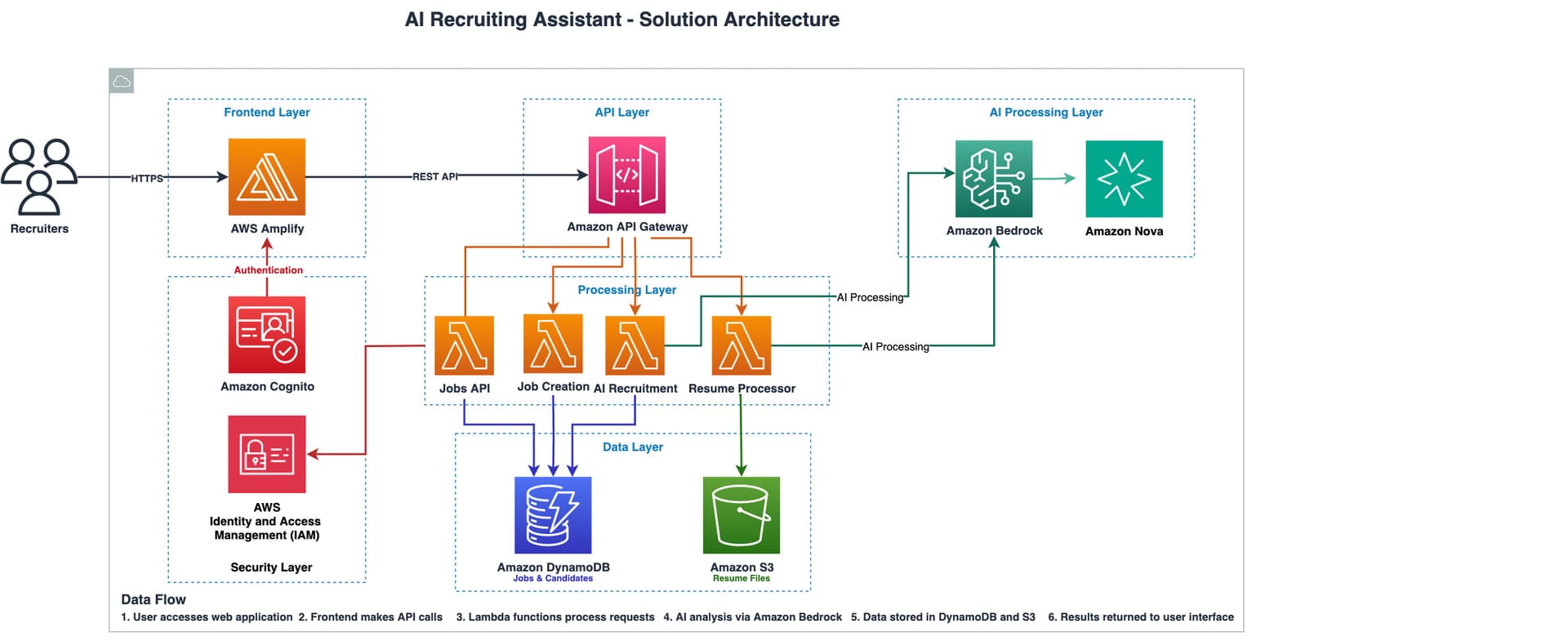
AWS published a reference architecture for building an AI-powered recruitment assistant using Amazon Bedrock that automates resume parsing, candidate scoring, skill assessment, and interview question generation. The solution addresses a documented problem where recruiters spend an average of 17.7 hours per vacancy on administrative work, with 45% of talent acquisition leaders spending more than half their time on automatable tasks. The system incorporates Amazon Bedrock Guardrails for PII anonymization, bias filtering, and prompt attack detection across a serverless architecture combining Lambda, API Gateway, DynamoDB, and S3.
Executive Summary
AWS has released a reference architecture for an AI-powered recruitment assistant built on Amazon Bedrock that automates core talent acquisition workflows including resume parsing, candidate scoring, and interview question generation. The solution addresses a significant operational burden, as recruiters currently spend 17.7 hours per vacancy on administrative tasks, with nearly half of talent acquisition leaders spending more than half their time on automatable work. The system incorporates built-in safeguards for data privacy, bias detection, and security through Bedrock Guardrails integrated into a serverless infrastructure.
Key Takeaways
- Recruiters spend an average of 17.7 hours per vacancy on administrative work, representing substantial opportunity for automation and productivity gains.
- AWS Bedrock enables end-to-end automation of recruitment tasks from resume parsing through interview question generation using large language models.
- Bedrock Guardrails provide critical controls for personally identifiable information anonymization, bias filtering, and prompt injection prevention within recruitment workflows.
- Serverless architecture combining Lambda, API Gateway, DynamoDB, and S3 reduces infrastructure complexity and operational overhead for implementing AI recruitment solutions.
- 45% of talent acquisition leaders report spending more than half their time on automatable tasks, indicating widespread industry readiness for AI-assisted recruitment.
Why It Matters
Automation of recruitment administrative work directly impacts both cost efficiency and hiring speed, addressing a critical pain point where nearly half of talent acquisition leaders are constrained by repetitive tasks rather than strategic candidate evaluation. Incorporating safety guardrails for bias and PII protection is essential for responsible AI deployment in human resources, where regulatory compliance and fairness concerns are paramount.
Deep Dive
The AWS reference architecture addresses a well-documented inefficiency in talent acquisition where recruiters allocate disproportionate time to administrative work rather than substantive candidate assessment. With an average of 17.7 hours spent per vacancy on automatable tasks and 45% of leaders reporting that more than half their time goes to such work, organizations face both financial drain and opportunity cost in recruiting cycles. AWS's Bedrock-based solution leverages large language models to handle resume parsing, skill extraction, candidate scoring, and interview question generation, substantially reducing manual workload.
The architecture's incorporation of Bedrock Guardrails represents a mature approach to responsible AI in human resources. Guardrails address three critical risk vectors: personally identifiable information anonymization to protect candidate privacy, bias filtering to reduce discriminatory outcomes in candidate scoring and assessment, and prompt attack detection to prevent malicious input manipulation. This multi-layered safety approach acknowledges that recruitment decisions have lasting consequences for candidates and organizational culture.
The serverless design using Lambda, API Gateway, DynamoDB, and S3 provides practical implementation advantages beyond the AI model layer. Serverless architecture eliminates the need for dedicated infrastructure management, scales automatically with recruitment volume, and aligns costs with actual usage rather than reserved capacity. This approach reduces barriers to entry for mid-sized organizations that may lack dedicated infrastructure teams, democratizing access to enterprise-grade AI recruitment capabilities.
The solution also implicitly addresses the quality versus speed tradeoff in modern recruitment. By automating initial screening and candidate ranking, human recruiters can focus on relationship building, culture fit assessment, and nuanced evaluation that requires human judgment. This division of labor between AI and human expertise, when properly implemented, can improve both hiring speed and candidate experience compared to current manual processes.
Expert Perspective
The combination of automation capability with built-in governance mechanisms reflects the current industry consensus that AI in human resources requires explicit safeguards. Rather than viewing Bedrock Guardrails as an afterthought, AWS embeds bias detection and PII protection into the core architecture, signaling that responsible AI deployment is foundational rather than optional. This approach aligns with emerging regulatory frameworks and organizational best practices around fair hiring, suggesting that recruitment assistant solutions will increasingly compete not just on feature set and cost, but on transparency and bias mitigation capabilities. The documented scale of administrative burden—17.7 hours per vacancy—suggests that organizations adopting such solutions will gain meaningful competitive advantage in time-to-hire metrics, but only if the solutions maintain hiring quality and fairness standards.
What to Do Next
- Evaluate your current talent acquisition workflows to quantify time spent on administrative versus strategic tasks, using the 17.7 hour benchmark and 45% figure as industry comparisons to identify potential automation opportunities.
- Review AWS Bedrock's recruitment reference architecture documentation to assess fit with your organization's technology stack, data governance requirements, and compliance obligations around PII and fair hiring practices.
- Establish governance criteria for AI-assisted recruitment including bias testing protocols, candidate feedback mechanisms, and explainability requirements before implementation to ensure fair outcomes.
- Pilot the solution with a limited volume of recruiting cycles to validate accuracy of resume parsing and candidate scoring against your organization's hiring outcomes before full-scale deployment.
Our Briefing
Weekly signal. No noise. Built for founders, operators, and AI-curious professionals.
No spam. Unsubscribe any time.