AWS Bedrock AgentCore targets multi-tenant AI agent deployments
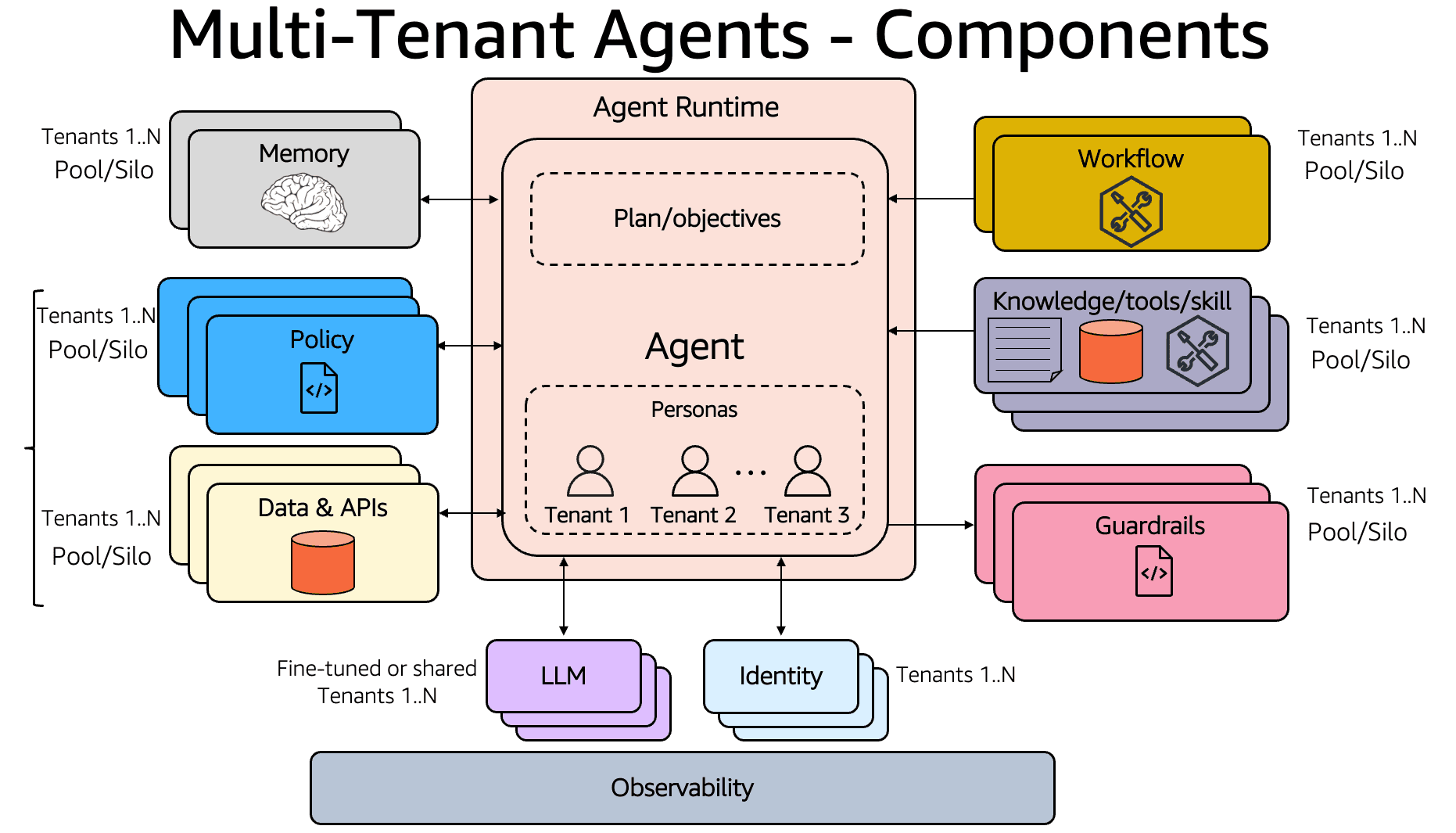
Amazon has released Bedrock AgentCore, a managed service for building multi-tenant AI agent applications with built-in support for tenant isolation, identity management, and observability. The service addresses architectural challenges SaaS providers face when deploying agents at scale, including data isolation, cost attribution, and preventing noisy neighbor problems. AgentCore uses session-isolated microVMs to balance security with operational efficiency, allowing tenant context to flow through HTTP headers without requiring dedicated infrastructure per tenant.
Executive Summary
Amazon has released Bedrock AgentCore, a managed service purpose-built for SaaS providers deploying multi-tenant AI agents at scale. The service addresses critical architectural challenges including tenant data isolation, cost attribution, and noisy neighbor prevention through session-isolated microVMs and header-based tenant context propagation.
Key Takeaways
- AgentCore eliminates the need for dedicated infrastructure per tenant by using session-isolated microVMs to enforce security boundaries while maintaining operational efficiency.
- Built-in tenant isolation, identity management, and observability features reduce the engineering burden on SaaS providers implementing multi-tenant agent architectures.
- Tenant context flows through HTTP headers without requiring architectural redesigns, enabling faster deployment of agent capabilities across existing SaaS platforms.
- The service addresses the noisy neighbor problem and cost attribution challenges that have historically complicated multi-tenant AI deployments in production environments.
Why It Matters
As SaaS providers increasingly deploy AI agents to serve multiple customers, managing data isolation, cost tracking, and preventing performance interference between tenants becomes a critical technical challenge. Bedrock AgentCore reduces this operational complexity significantly, accelerating the path to production for multi-tenant agent applications.
Deep Dive
Multi-tenant AI agent deployments present unique architectural challenges that traditional single-tenant approaches cannot efficiently solve. SaaS providers must ensure strict data isolation between customers, accurately attribute compute and API costs to individual tenants, and prevent resource contention where one tenant's workload degrades performance for others. Bedrock AgentCore addresses these challenges through session-isolated microVMs, which provide security and isolation without requiring separate infrastructure instances for each tenant, reducing operational overhead and cost. The service's use of HTTP headers to propagate tenant context means existing SaaS applications can integrate AgentCore without fundamental architectural changes. This is particularly valuable for established platforms seeking to add agentic AI capabilities to their offerings. The inclusion of built-in observability enables operators to track agent execution across tenants, monitor performance, and identify issues specific to individual customers. Amazon's approach balances the security requirements of multi-tenancy with the operational efficiency needed for cost-effective deployment at scale. By offloading these architectural concerns to a managed service, SaaS companies can focus engineering effort on agent logic and business value rather than infrastructure and isolation patterns.
Expert Perspective
From an infrastructure and platform engineering perspective, Bedrock AgentCore represents a maturation of the multi-tenant SaaS model applied to AI agents. The service acknowledges that agents differ from traditional application workloads in their reliance on tool use, memory management, and asynchronous execution, requiring purpose-built isolation mechanisms. The microVM-based approach offers a pragmatic middle ground between the security guarantees of process-level isolation and the cost efficiency of shared compute pools. For SaaS vendors, this reduces time-to-market for agent features and shifts risk from product teams to AWS, which has operational incentives to maintain tenant isolation. The observability and cost attribution features signal that AWS understands the operational maturity required to run agents in production environments serving multiple paying customers.
What to Do Next
- Evaluate whether your SaaS platform's multi-tenant architecture would benefit from dedicated agent capabilities and assess AgentCore's isolation model against your security and compliance requirements.
- Review your current tenant context propagation mechanisms to identify how existing application logic could integrate with AgentCore's header-based approach without requiring extensive refactoring.
- Conduct a pilot deployment of AgentCore with a subset of tenants to validate cost attribution accuracy, performance consistency, and observability coverage for your specific use cases.
- Engage with AWS on pricing and scaling characteristics for your expected agent usage patterns to understand long-term cost implications compared to building multi-tenant agents on foundation models alone.
Our Briefing
Weekly signal. No noise. Built for founders, operators, and AI-curious professionals.
No spam. Unsubscribe any time.