VFF - The signal in the noise
NewsTrending

Robinhood Lets AI Agents Trade Stocks Autonomously

Ivan MehtaRead original
Share
Robinhood Lets AI Agents Trade Stocks Autonomously

Robinhood has introduced a feature allowing users to create separate trading accounts with pre-loaded balances that AI agents can autonomously trade from. The move extends the brokerage's platform into autonomous trading, enabling users to delegate investment decisions to AI systems. This represents a significant shift in retail investing infrastructure, blurring lines between user-directed and algorithmic trading.

  • Robinhood users can now create dedicated accounts for AI agents to trade autonomously
  • Accounts come with pre-loaded balances controlled by the AI system
  • Feature extends Robinhood's platform into autonomous investment management
  • Raises questions about retail investor protection and algorithmic trading oversight

This feature democratizes autonomous trading access for retail investors, previously available mainly to institutional players. It signals a fundamental shift in how retail brokerages are positioning themselves around AI capabilities. The move also raises regulatory and risk management questions about unsupervised algorithmic trading at scale among retail users.

For Robinhood, this is a competitive differentiation play in an increasingly commoditized retail brokerage market. It positions the platform as AI-native and appeals to tech-forward users. However, it introduces operational and compliance risks that could impact the company's regulatory standing and customer protection obligations.

  • Retail investors now have access to autonomous trading infrastructure previously limited to institutional investors
  • Regulatory bodies will likely scrutinize how AI agents operate within retail accounts and what safeguards exist
  • Market volatility could increase if large numbers of retail users deploy similar AI trading strategies simultaneously
  • Liability questions emerge around who bears responsibility for losses from autonomous trading decisions

Monitor how regulators respond to autonomous retail trading, particularly the SEC and FINRA. Watch for any incidents involving significant losses or market disruption tied to AI agent trading. Track whether other brokerages follow suit and what guardrails they implement around autonomous trading access.

Related Video

Share

Our Briefing

Weekly signal. No noise. Built for founders, operators, and AI-curious professionals.

No spam. Unsubscribe any time.

Related stories

Google DeepMind Releases Gemma 4 12B for Laptop-Based AI
TrendingNews

Google DeepMind Releases Gemma 4 12B for Laptop-Based AI

Google DeepMind introduced Gemma 4 12B, a multimodal AI model designed to run on consumer laptops with 16GB of RAM. The model uses an encoder-free architecture that processes vision and audio inputs directly into the language model backbone, reducing latency and memory overhead. Performance approaches the larger 26B model while maintaining a smaller footprint, and it is released under an Apache 2.0 license.

about 20 hours ago· Google Deepmind
Open-Source Search Agent Outperforms GPT-5.4
TrendingNews

Open-Source Search Agent Outperforms GPT-5.4

Researchers from UIUC, UC Berkeley, and Chroma released Harness-1, a 20-billion parameter open-source search agent that scores 73% on information recall benchmarks, outperforming GPT-5.4 (70.9%) and other proprietary models. The model is available under Apache 2.0 license on Hugging Face. Harness-1 achieves its performance by offloading search session management to a structured software environment rather than relying on expanded context windows, suggesting that model efficiency matters more than raw parameter size for autonomous retrieval tasks.

by carl.franzen@venturebeat.com (Carl Franzen)about 24 hours ago· VentureBeat AI
OpenEnv Shifts to Community Governance for Open Source Agents

OpenEnv Shifts to Community Governance for Open Source Agents

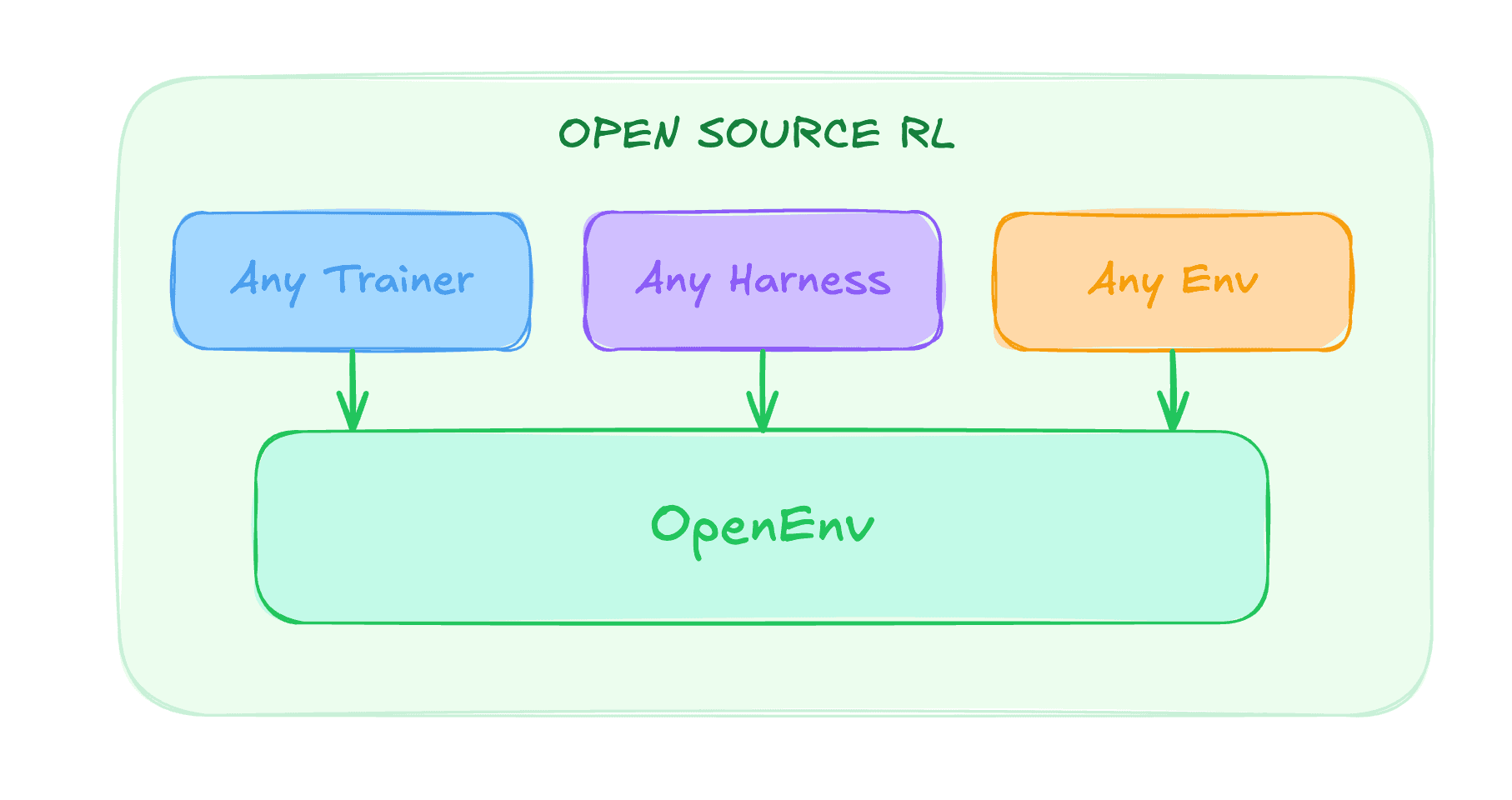
OpenEnv, a tool for building agentic execution environments, is transitioning to community governance with a steering committee that includes Meta, Nvidia, Hugging Face, and others. The project is being repositioned as a protocol layer for standardizing how RL environments are published and consumed by agents, rather than dictating reward frameworks or training logic. This move aims to enable open source models to achieve the same training efficiency that frontier labs achieve by co-optimizing models with their execution harnesses.

2 days ago· Hugging Face Blog
Why AI Agents Can't Learn Across Your Team
TrendingNews

Why AI Agents Can't Learn Across Your Team

AI agents deployed across enterprises fail to share corrections and learnings between team members, creating isolated versions of the same tool that never sync. Asana and other platforms are building shared memory architectures to solve this problem, but the challenge of storing, controlling, and maintaining consistency across multi-agent workflows remains largely unsolved. According to Asana research, 75% of knowledge workers use AI on the job, yet only 5% of companies report productivity gains, partly because agents lack enterprise context and shared learning.

2 days ago· VentureBeat AI