VFF - The signal in the noise
News

Adobe's AI Design Agent Promises Control but Delivers Mediocre Results

Jess WeatherbedRead original
Share
Adobe's AI Design Agent Promises Control but Delivers Mediocre Results

Adobe's Firefly AI Assistant takes a different approach to AI-assisted design by functioning as a conversational agent that operates Adobe's apps rather than generating images from scratch. The tool aims to reduce busywork while preserving user creative control, though early testing suggests the execution falls short of the ambition. The assistant can explain its editing process clearly but produces mediocre results that don't meaningfully advance the creative workflow.

  • Adobe's Firefly AI Assistant operates as a multitasking middleman within Adobe's design apps rather than a standalone image generator
  • The tool is designed to handle busywork while maintaining user creative control over the design process
  • Early beta testing shows clear explanations of editing processes but underwhelming actual output quality
  • The approach differs from typical AI image tools by integrating into existing professional workflows rather than replacing designer judgment

Adobe's approach signals a shift in how AI assistants could integrate into professional creative work, prioritizing workflow assistance over full automation. However, the gap between concept and execution raises questions about whether current AI can meaningfully support professional designers without becoming either a hindrance or a replacement that removes creative agency.

For Adobe, this represents an attempt to embed AI deeper into its Creative Cloud suite to increase user retention and justify subscription costs. Success or failure here will influence how other software vendors approach AI integration, particularly whether users value AI assistance that preserves control versus tools that automate decisions entirely.

  • AI assistants in professional software may need to prioritize transparency and explainability over pure output quality to gain designer trust
  • The market may differentiate between AI tools for non-professionals (quick results) and AI tools for professionals (workflow enhancement with control)
  • Adobe's middleman approach could become a template for other creative software, but only if execution quality improves significantly

Monitor whether Adobe iterates on Firefly's output quality and user adoption rates post-launch. Track how competing design platforms respond with their own AI agents, and whether professional designers actually adopt these tools or continue relying on traditional workflows. Pay attention to feedback on whether the transparency of AI decision-making becomes a differentiator in the market.

Share

Our Briefing

Weekly signal. No noise. Built for founders, operators, and AI-curious professionals.

No spam. Unsubscribe any time.

Related stories

Google DeepMind Releases Gemma 4 12B for Laptop-Based AI
TrendingNews

Google DeepMind Releases Gemma 4 12B for Laptop-Based AI

Google DeepMind introduced Gemma 4 12B, a multimodal AI model designed to run on consumer laptops with 16GB of RAM. The model uses an encoder-free architecture that processes vision and audio inputs directly into the language model backbone, reducing latency and memory overhead. Performance approaches the larger 26B model while maintaining a smaller footprint, and it is released under an Apache 2.0 license.

about 19 hours ago· Google Deepmind
Open-Source Search Agent Outperforms GPT-5.4
TrendingNews

Open-Source Search Agent Outperforms GPT-5.4

Researchers from UIUC, UC Berkeley, and Chroma released Harness-1, a 20-billion parameter open-source search agent that scores 73% on information recall benchmarks, outperforming GPT-5.4 (70.9%) and other proprietary models. The model is available under Apache 2.0 license on Hugging Face. Harness-1 achieves its performance by offloading search session management to a structured software environment rather than relying on expanded context windows, suggesting that model efficiency matters more than raw parameter size for autonomous retrieval tasks.

by carl.franzen@venturebeat.com (Carl Franzen)about 24 hours ago· VentureBeat AI
OpenEnv Shifts to Community Governance for Open Source Agents

OpenEnv Shifts to Community Governance for Open Source Agents

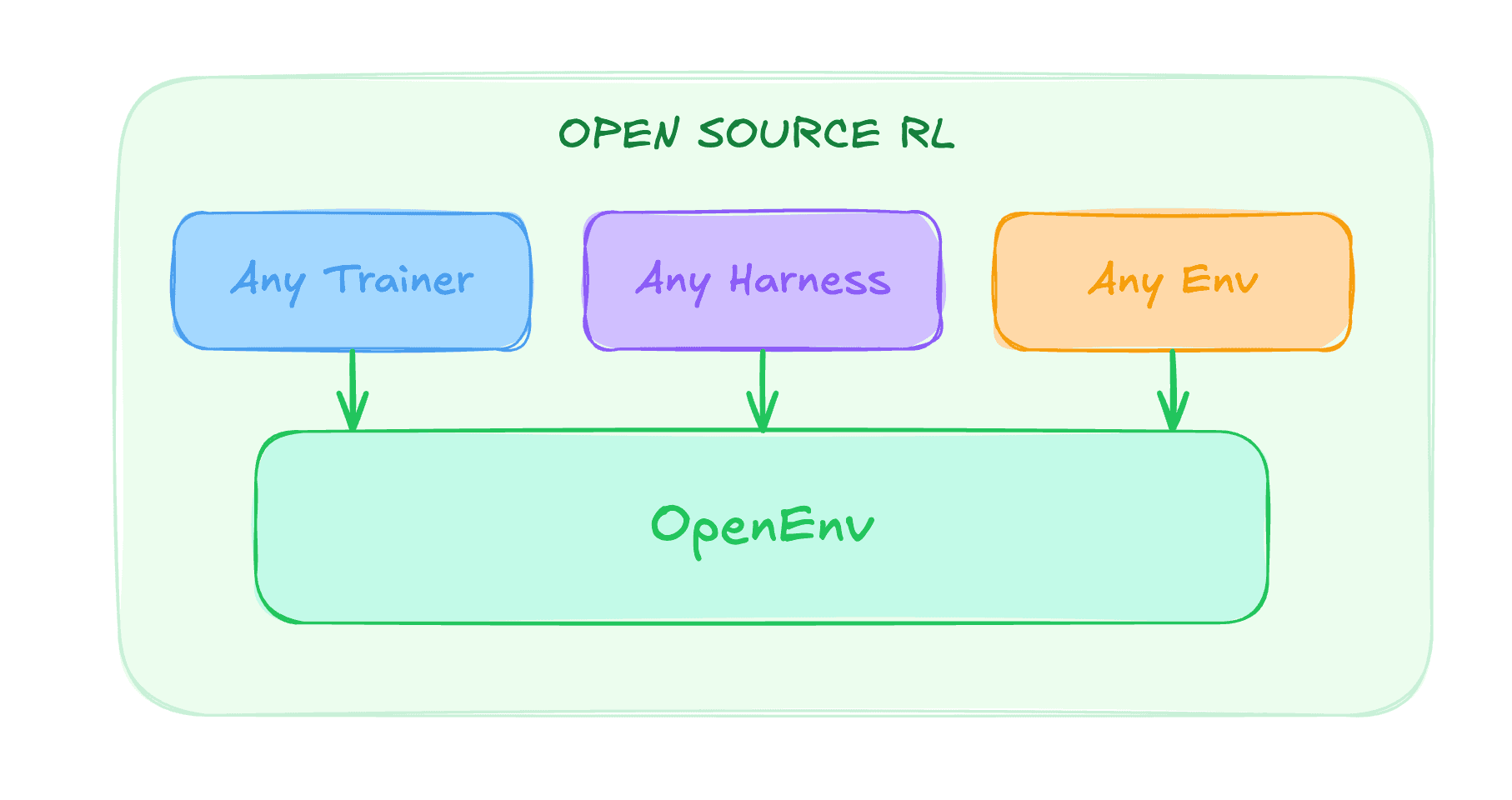
OpenEnv, a tool for building agentic execution environments, is transitioning to community governance with a steering committee that includes Meta, Nvidia, Hugging Face, and others. The project is being repositioned as a protocol layer for standardizing how RL environments are published and consumed by agents, rather than dictating reward frameworks or training logic. This move aims to enable open source models to achieve the same training efficiency that frontier labs achieve by co-optimizing models with their execution harnesses.

2 days ago· Hugging Face Blog
Why AI Agents Can't Learn Across Your Team
TrendingNews

Why AI Agents Can't Learn Across Your Team

AI agents deployed across enterprises fail to share corrections and learnings between team members, creating isolated versions of the same tool that never sync. Asana and other platforms are building shared memory architectures to solve this problem, but the challenge of storing, controlling, and maintaining consistency across multi-agent workflows remains largely unsolved. According to Asana research, 75% of knowledge workers use AI on the job, yet only 5% of companies report productivity gains, partly because agents lack enterprise context and shared learning.

2 days ago· VentureBeat AI