VFF - The signal in the noise
NewsTrending

Intel to Ship Crescent AI Chip This Year to Challenge Nvidia
Qianer LiuRead original
Share
Intel to Ship Crescent AI Chip This Year to Challenge Nvidia

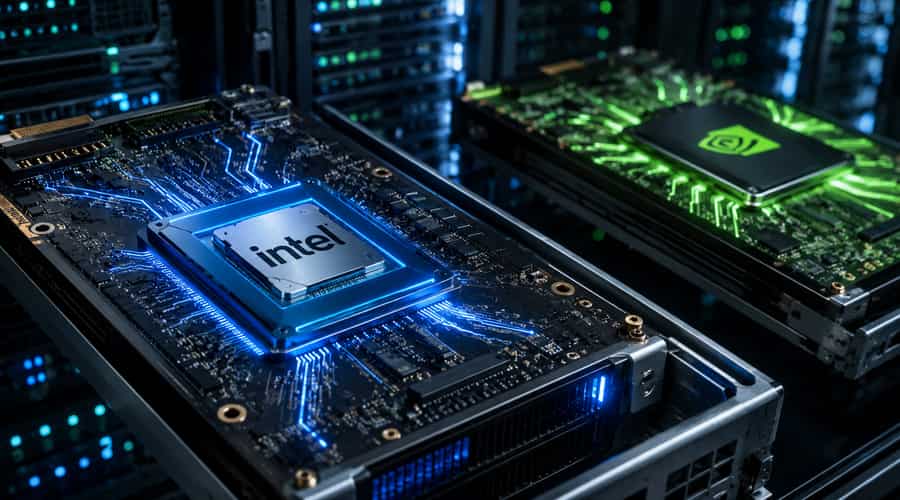
Intel plans to ship a new AI chip codenamed Crescent by year-end, according to Kevork Kechichian, who leads the company's data centre group. The processor is positioned as a cheaper, simpler alternative to Nvidia's dominant offerings. Intel is betting this approach can carve out market share in the AI chip space where Nvidia currently holds substantial control.

  • Intel will release AI chip 'Crescent' before end of 2026
  • Strategy focuses on cost and simplicity versus Nvidia's premium positioning
  • Move targets data centre market where Nvidia dominates
  • Kevork Kechichian leading Intel's data centre group confirmed timeline

Nvidia's near-monopoly on AI accelerators has created supply constraints and pricing power that limit adoption across enterprises. Intel's entry with a cost-focused alternative could disrupt this dynamic and force competitive pressure on pricing and availability. Success here would reshape the infrastructure layer supporting AI deployment across industries.

For enterprises evaluating AI infrastructure, a viable Intel alternative reduces vendor lock-in risk and could lower total cost of ownership. For Intel, capturing even modest market share in AI chips represents a significant revenue opportunity and validates its data centre strategy after years of competitive losses to AMD and others.

  • Nvidia's pricing power in AI accelerators may face downward pressure if Crescent gains traction
  • Enterprise customers gain optionality in AI chip sourcing, reducing dependency on single supplier
  • Intel's data centre division has a concrete near-term product milestone to execute against

Monitor Crescent's actual performance benchmarks against Nvidia H100 and H200 chips once available. Track early customer adoption rates and which workloads or use cases Intel targets first. Watch for any delays beyond the stated 2026 timeline, which would signal execution challenges.

Share

Our Briefing

Weekly signal. No noise. Built for founders, operators, and AI-curious professionals.

No spam. Unsubscribe any time.

Related stories

E-scooter founder launches $5M space data center startup

E-scooter founder launches $5M space data center startup

Euwyn Poon, former founder of e-scooter company Spin, has raised $5 million to launch Orbital, a startup planning to build 10,000 space-based data centers. Poon previously scaled Spin to 250,000 scooters before exiting that venture. The funding signals investor interest in orbital infrastructure as a new computing frontier, though the technical and regulatory challenges remain substantial.

by Tim Fernholzabout 20 hours ago· TechCrunch AI
Seattle votes on data center moratorium as Amazon employees push back

Seattle votes on data center moratorium as Amazon employees push back

Seattle City Council will vote June 9th on a one-year moratorium on new data centers, just two months after companies proposed five large-scale facilities in the city. Amazon employees have joined other supporters in testifying for the moratorium, citing concerns about water consumption, electricity prices, and noise. The vote reflects growing tension between tech infrastructure expansion and local environmental and operational impacts.

by Hayden Fieldabout 24 hours ago· The Verge AI
Google, Nvidia Eye Intel as TSMC Backup

Google, Nvidia Eye Intel as TSMC Backup

TSMC's capacity constraints are prompting major AI chip designers, including Google and Nvidia, to explore Intel as a backup manufacturer for advanced processors. The shift reflects growing demand for AI chip production that outpaces TSMC's current manufacturing capacity. Intel stands to benefit from diversification of supply chains among leading AI companies.

by Qianer Liu2 days ago· The Information
Stargate Data Center Faces Unexpected Power Integration Costs
TrendingNews

Stargate Data Center Faces Unexpected Power Integration Costs

Crusoe Energy, the data center developer building OpenAI's Stargate supercomputer facility in Abilene, Texas, is facing higher-than-expected costs and technical challenges integrating natural gas turbines with the AI infrastructure. Engineers have been working overtime to resolve compatibility issues between the power generation system and one of the most expensive AI supercomputers ever built. The project, part of OpenAI's broader Stargate computing initiative, is encountering obstacles that were not anticipated during initial planning.

by Ann Davis Vaughan2 days ago· The Information