VFF - The signal in the noise
News

Salesforce Buys Contentful to Boost AI Agent Access to Data

Kevin McLaughlinRead original
Share
Salesforce Buys Contentful to Boost AI Agent Access to Data

Salesforce is acquiring Contentful, a content management software provider, as part of a broader effort to make customer data more accessible to AI agents. The deal value falls between $1 billion and $1.5 billion, though exact terms were not disclosed. The acquisition reflects Salesforce's strategy to integrate AI capabilities across its platform by connecting content management with its existing customer data infrastructure.

  • Salesforce acquiring Contentful, a content management software provider
  • Deal valued between $1 billion and $1.5 billion
  • Move aims to improve AI agents' access to customer data
  • Part of Salesforce's broader AI integration strategy

Enterprise software vendors are racing to embed AI agents into their platforms, and data accessibility is a critical bottleneck. By acquiring Contentful, Salesforce gains a tool to unify content and customer data, making it easier for AI systems to access and act on business information. This reflects a broader industry trend of consolidation around AI-ready infrastructure.

For Salesforce customers, the acquisition could streamline workflows by enabling AI agents to pull from both structured customer data and unstructured content without manual integration. For content-heavy businesses, this integration may reduce friction in deploying AI-driven customer experiences and automating content-related tasks.

  • Salesforce is betting that content management is essential infrastructure for enterprise AI agents
  • The acquisition signals consolidation in the CMS market as larger platforms absorb specialized tools
  • Customers may see tighter integration between Salesforce's CRM and content management capabilities

Monitor whether Salesforce successfully integrates Contentful's capabilities into its core platform and how customers respond to the unified offering. Watch for competitive moves from other enterprise software vendors, particularly those building AI agent platforms, to acquire or build similar content accessibility features.

Share

Our Briefing

Weekly signal. No noise. Built for founders, operators, and AI-curious professionals.

No spam. Unsubscribe any time.

Related stories

Google DeepMind Releases Gemma 4 12B for Laptop-Based AI
TrendingNews

Google DeepMind Releases Gemma 4 12B for Laptop-Based AI

Google DeepMind introduced Gemma 4 12B, a multimodal AI model designed to run on consumer laptops with 16GB of RAM. The model uses an encoder-free architecture that processes vision and audio inputs directly into the language model backbone, reducing latency and memory overhead. Performance approaches the larger 26B model while maintaining a smaller footprint, and it is released under an Apache 2.0 license.

about 20 hours ago· Google Deepmind
Open-Source Search Agent Outperforms GPT-5.4
TrendingNews

Open-Source Search Agent Outperforms GPT-5.4

Researchers from UIUC, UC Berkeley, and Chroma released Harness-1, a 20-billion parameter open-source search agent that scores 73% on information recall benchmarks, outperforming GPT-5.4 (70.9%) and other proprietary models. The model is available under Apache 2.0 license on Hugging Face. Harness-1 achieves its performance by offloading search session management to a structured software environment rather than relying on expanded context windows, suggesting that model efficiency matters more than raw parameter size for autonomous retrieval tasks.

by carl.franzen@venturebeat.com (Carl Franzen)about 24 hours ago· VentureBeat AI
OpenEnv Shifts to Community Governance for Open Source Agents

OpenEnv Shifts to Community Governance for Open Source Agents

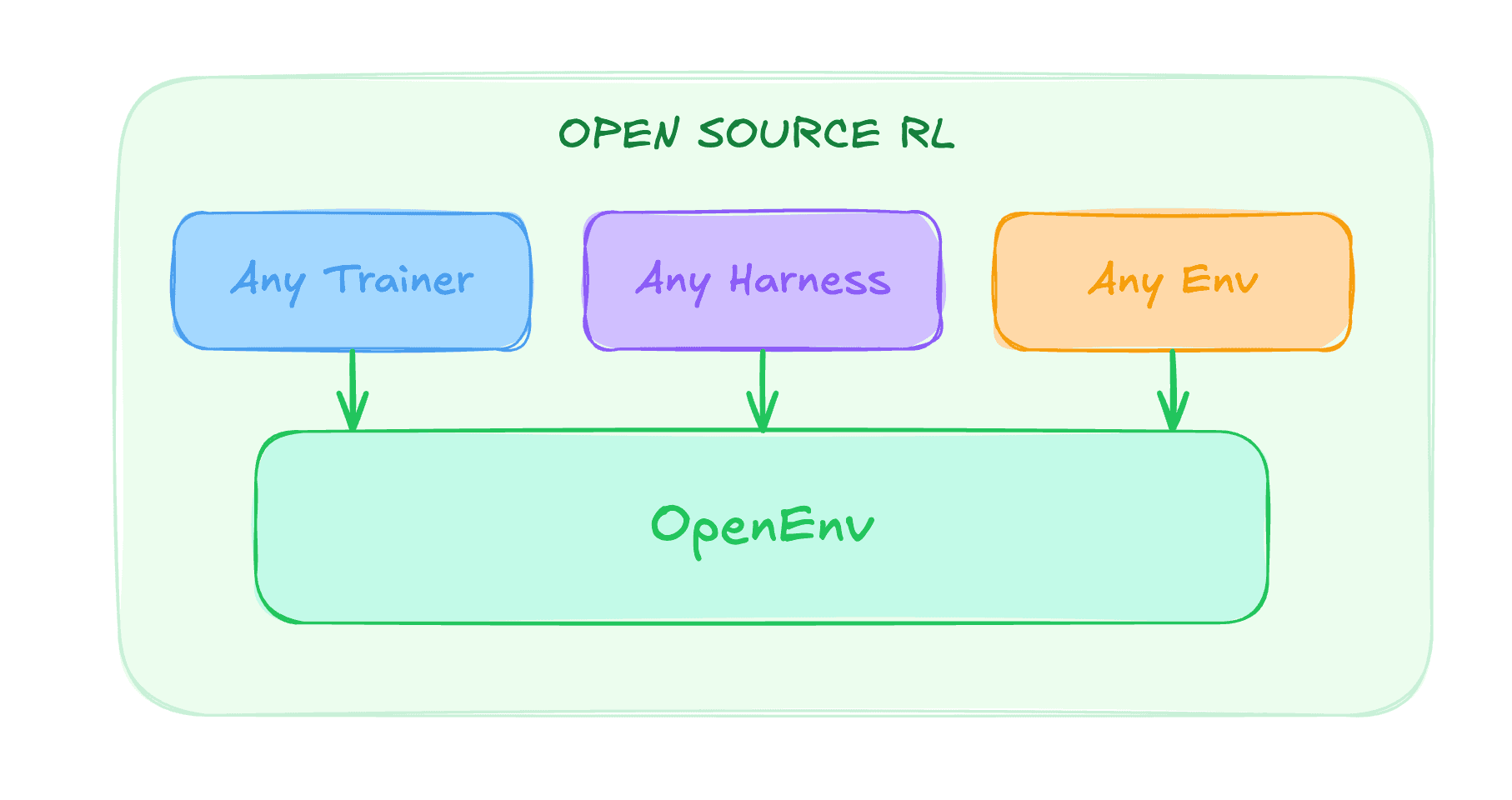
OpenEnv, a tool for building agentic execution environments, is transitioning to community governance with a steering committee that includes Meta, Nvidia, Hugging Face, and others. The project is being repositioned as a protocol layer for standardizing how RL environments are published and consumed by agents, rather than dictating reward frameworks or training logic. This move aims to enable open source models to achieve the same training efficiency that frontier labs achieve by co-optimizing models with their execution harnesses.

2 days ago· Hugging Face Blog
Why AI Agents Can't Learn Across Your Team
TrendingNews

Why AI Agents Can't Learn Across Your Team

AI agents deployed across enterprises fail to share corrections and learnings between team members, creating isolated versions of the same tool that never sync. Asana and other platforms are building shared memory architectures to solve this problem, but the challenge of storing, controlling, and maintaining consistency across multi-agent workflows remains largely unsolved. According to Asana research, 75% of knowledge workers use AI on the job, yet only 5% of companies report productivity gains, partly because agents lack enterprise context and shared learning.

2 days ago· VentureBeat AI