AWS Launches Fundamental's NEXUS for Tabular Data Prediction
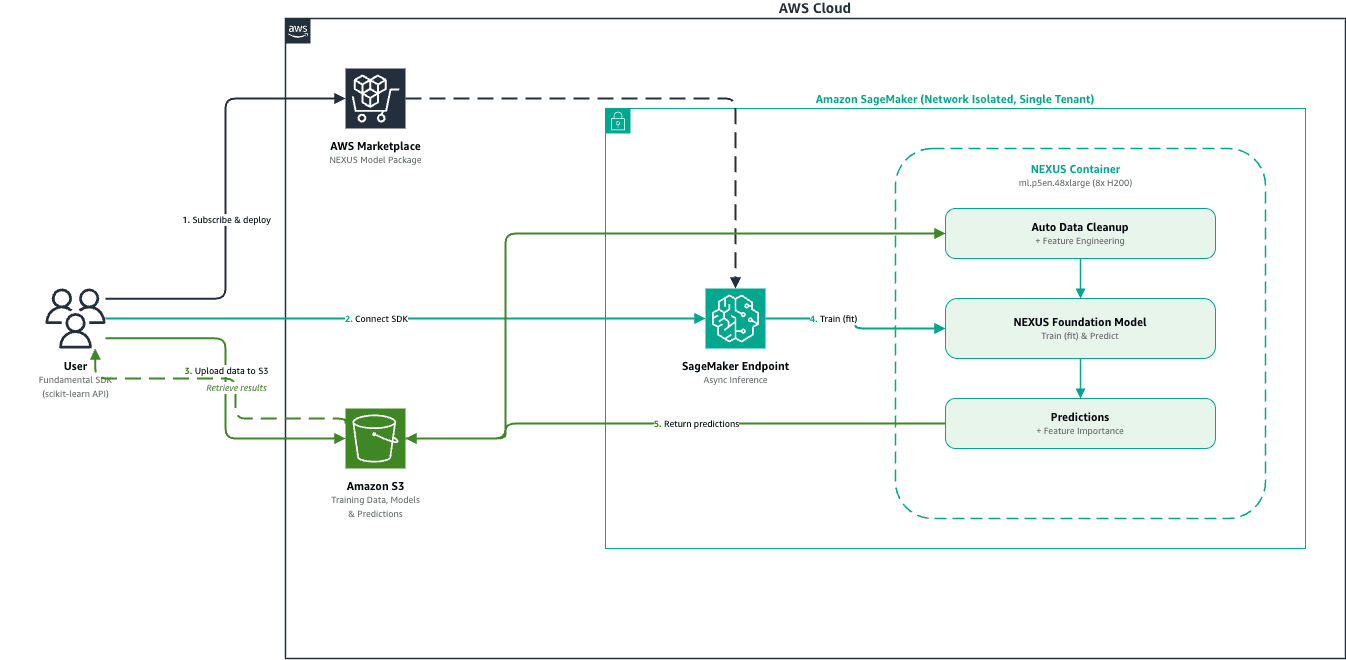
AWS has made Fundamental's NEXUS, a foundation model designed specifically for tabular data prediction, available on Amazon SageMaker JumpStart. NEXUS is pre-trained on billions of real-world prediction tasks and produces deterministic, reproducible results without requiring extensive feature engineering. The model addresses limitations of traditional machine learning, which takes 3-6 months to deploy, and large language models, which are non-deterministic and lose numerical context on structured data.
TL;DR
- Fundamental's NEXUS foundation model is now available on Amazon SageMaker JumpStart for tabular data prediction
- NEXUS produces deterministic, reproducible results and processes structured data without manual feature engineering
- The model is pre-trained on billions of real-world prediction tasks across structured datasets
- Key capabilities include permutation invariance, billion-row processing, cross-schema reasoning, and autonomous data cleaning
Why It Matters
Foundation models have been optimized for text and images, leaving a gap for structured data analysis. NEXUS fills that gap by being purpose-built for tabular data, which represents the majority of enterprise data in spreadsheets, ERP systems, CRM systems, and relational databases. This addresses a real bottleneck where critical business decisions depend on predictions from structured data but existing tools require months of development or sacrifice accuracy.
Business Impact
Enterprises can now generate accurate predictions from structured data in days instead of the 3-6 months required by traditional machine learning approaches. The deterministic nature of NEXUS eliminates the unpredictability of LLMs on numerical data, reducing the need for complex guardrails and making predictions more reliable for business decision-making. Integration with SageMaker JumpStart lowers the barrier to deployment for organizations already using AWS infrastructure.
Key Implications
- Tabular data prediction workflows could shift from multi-month projects requiring specialized data science teams to faster deployments using pre-trained models
- Organizations may reduce reliance on traditional ML approaches and LLM-based workarounds for structured data tasks
- The availability on SageMaker JumpStart positions AWS to capture adoption among enterprises with significant tabular data workloads
What to Watch
Monitor adoption rates among AWS customers and whether competing cloud providers introduce similar tabular-specific foundation models. Track whether NEXUS's deterministic architecture and autonomous data cleaning capabilities deliver the promised accuracy improvements in real-world deployments. Watch for expansion of NEXUS capabilities or pricing changes as AWS integrates the model more deeply into its SageMaker ecosystem.
Our Briefing
Weekly signal. No noise. Built for founders, operators, and AI-curious professionals.
No spam. Unsubscribe any time.


