VFF - The signal in the noise
News

Endava Rebuilds Software Delivery Around AI Agents
Read original
Share
Endava Rebuilds Software Delivery Around AI Agents

Endava is restructuring its software delivery operations around AI agents, leveraging ChatGPT Enterprise and Codex to automate workflows and accelerate development cycles. The company is building an AI-native culture across its enterprise to improve delivery speed and efficiency. This shift reflects how established software services firms are integrating generative AI into core business processes rather than treating it as a peripheral capability.

  • Endava is redesigning software delivery workflows using AI agents and ChatGPT Enterprise
  • The company is deploying Codex to automate code-related tasks and accelerate development
  • Endava is cultivating an AI-native organizational culture across the enterprise
  • The initiative aims to improve software delivery speed and operational efficiency

As a major software services provider, Endava's adoption of AI agents signals how enterprise software delivery is shifting from human-centric to AI-augmented workflows. This approach could reshape expectations for delivery timelines and cost structures across the industry, affecting both clients and competitors who must adapt or risk falling behind.

For enterprises using Endava or similar vendors, AI-driven delivery could reduce project timelines and costs. For competitors, the move raises pressure to integrate AI agents into their own delivery models or lose competitive advantage in pricing and speed.

  • AI agents are moving from experimental projects to core operational infrastructure in enterprise software delivery
  • Companies that embed AI agents into workflows early may establish structural advantages in speed and cost that are difficult for competitors to match
  • Organizational culture and training become critical differentiators as firms transition to AI-native operations

Monitor whether Endava's AI-native approach translates to measurable improvements in delivery speed, cost, and quality metrics. Watch for whether other large software services firms adopt similar strategies and how client expectations around timelines and pricing shift in response. Track whether this model creates new skill gaps or changes hiring and training requirements across the industry.

Share

Our Briefing

Weekly signal. No noise. Built for founders, operators, and AI-curious professionals.

No spam. Unsubscribe any time.

Related stories

Google DeepMind Releases Gemma 4 12B for Laptop-Based AI
TrendingNews

Google DeepMind Releases Gemma 4 12B for Laptop-Based AI

Google DeepMind introduced Gemma 4 12B, a multimodal AI model designed to run on consumer laptops with 16GB of RAM. The model uses an encoder-free architecture that processes vision and audio inputs directly into the language model backbone, reducing latency and memory overhead. Performance approaches the larger 26B model while maintaining a smaller footprint, and it is released under an Apache 2.0 license.

about 20 hours ago· Google Deepmind
Open-Source Search Agent Outperforms GPT-5.4
TrendingNews

Open-Source Search Agent Outperforms GPT-5.4

Researchers from UIUC, UC Berkeley, and Chroma released Harness-1, a 20-billion parameter open-source search agent that scores 73% on information recall benchmarks, outperforming GPT-5.4 (70.9%) and other proprietary models. The model is available under Apache 2.0 license on Hugging Face. Harness-1 achieves its performance by offloading search session management to a structured software environment rather than relying on expanded context windows, suggesting that model efficiency matters more than raw parameter size for autonomous retrieval tasks.

by carl.franzen@venturebeat.com (Carl Franzen)about 24 hours ago· VentureBeat AI
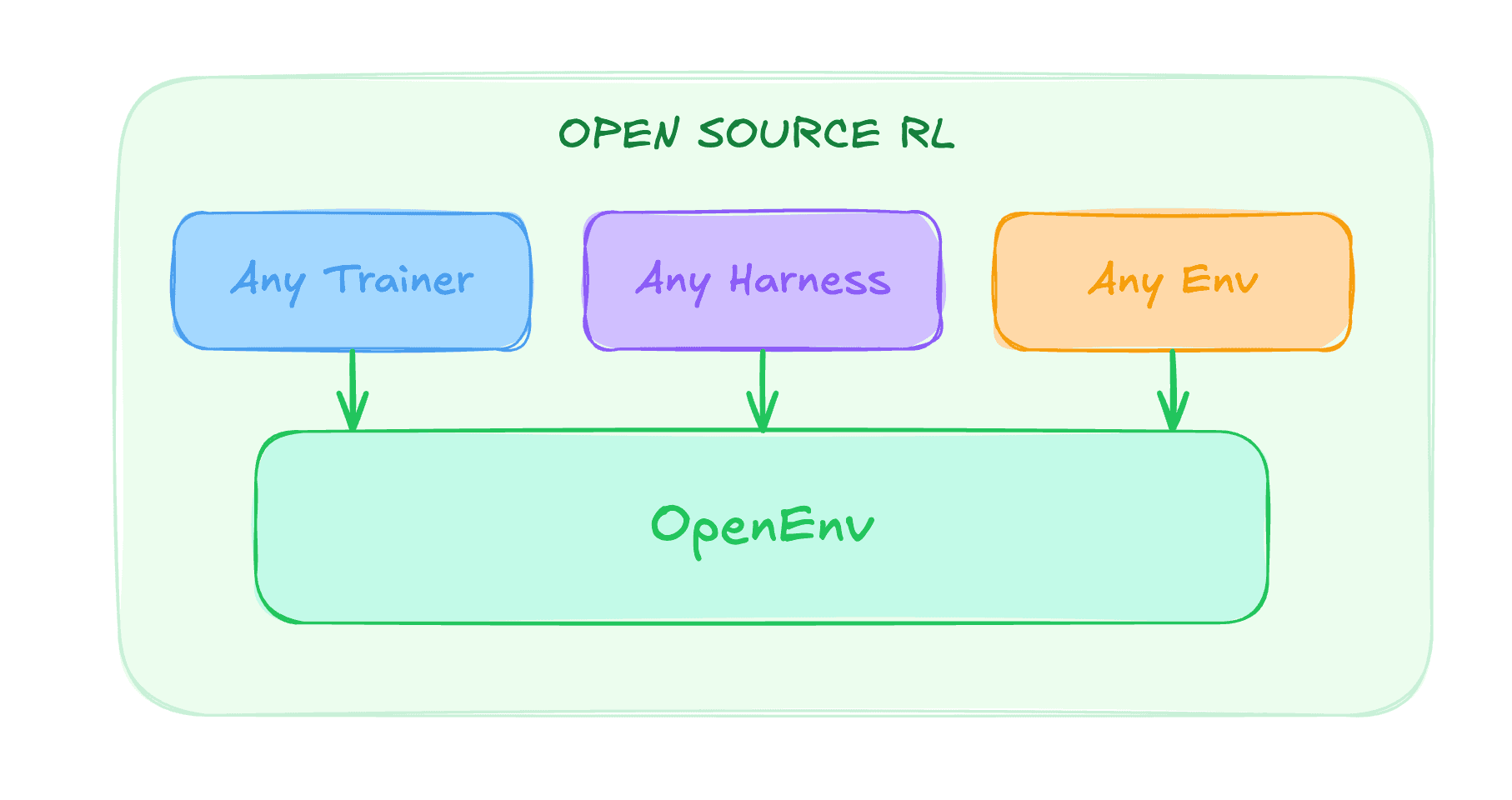
OpenEnv Shifts to Community Governance for Open Source Agents

OpenEnv Shifts to Community Governance for Open Source Agents

OpenEnv, a tool for building agentic execution environments, is transitioning to community governance with a steering committee that includes Meta, Nvidia, Hugging Face, and others. The project is being repositioned as a protocol layer for standardizing how RL environments are published and consumed by agents, rather than dictating reward frameworks or training logic. This move aims to enable open source models to achieve the same training efficiency that frontier labs achieve by co-optimizing models with their execution harnesses.

2 days ago· Hugging Face Blog
Why AI Agents Can't Learn Across Your Team
TrendingNews

Why AI Agents Can't Learn Across Your Team

AI agents deployed across enterprises fail to share corrections and learnings between team members, creating isolated versions of the same tool that never sync. Asana and other platforms are building shared memory architectures to solve this problem, but the challenge of storing, controlling, and maintaining consistency across multi-agent workflows remains largely unsolved. According to Asana research, 75% of knowledge workers use AI on the job, yet only 5% of companies report productivity gains, partly because agents lack enterprise context and shared learning.

2 days ago· VentureBeat AI