VFF - The signal in the noise
NewsTrending

Meta Plans $200/Month AI Agent as Premium Offering

Jyoti MannRead original
Share
Meta Plans $200/Month AI Agent as Premium Offering

Meta is planning to charge up to $199.99 per month for Hatch, a consumer-facing AI agent tool currently in development. The pricing would be tiered, with the premium tier offering higher usage limits. This positions Meta to compete directly with established AI providers at the high end of the market, though final pricing decisions remain unmade.

  • Meta's planned Hatch AI agent could launch with a $199.99 monthly premium tier
  • Tiered pricing structure would include higher usage limits at the top tier
  • Pricing reflects Meta's ambition to compete with top-tier AI offerings from established giants
  • Final pricing decisions have not yet been finalized, per internal documents

Meta's willingness to charge premium prices for AI agents signals confidence in consumer demand for advanced AI tools and marks a shift toward monetizing AI capabilities beyond advertising. The $200 monthly price point indicates Meta sees AI agents as a core product category worth positioning at parity with established competitors.

For enterprises and professionals, this pricing suggests Meta is targeting power users and businesses willing to pay for higher usage limits and advanced features. The tiered model allows Meta to capture different customer segments while establishing Hatch as a premium offering in a competitive market.

  • Meta is moving beyond ad-supported models to direct consumer revenue from AI products
  • Premium AI agent pricing is becoming normalized at the $200/month level across the industry
  • Tiered pricing structures allow Meta to serve both casual and power users within a single product

Monitor whether Meta finalizes pricing at or near the $199.99 level and how it compares to competing AI agent offerings at launch. Track adoption rates and usage patterns across pricing tiers to understand demand elasticity for premium AI agent features. Watch for any adjustments to pricing strategy based on competitive responses from other AI providers.

Share

Our Briefing

Weekly signal. No noise. Built for founders, operators, and AI-curious professionals.

No spam. Unsubscribe any time.

Related stories

AWS Quick and New Relic automate incident triage

AWS Quick and New Relic automate incident triage

AWS has released a template for building an incident triage assistant using Amazon Quick and New Relic's Model Context Protocol Server. The agent automates evidence gathering, root cause analysis, and task creation in a single conversational workflow. Internal testing showed the tool reduced the evidence-gathering phase of incident triage, lowering mean time to resolution and improving consistency across on-call rotations.

by Ebbey Thomas1 minute ago· AWS Machine Learning Blog
Google DeepMind Releases Gemma 4 12B for Laptop-Based AI
TrendingNews

Google DeepMind Releases Gemma 4 12B for Laptop-Based AI

Google DeepMind introduced Gemma 4 12B, a multimodal AI model designed to run on consumer laptops with 16GB of RAM. The model uses an encoder-free architecture that processes vision and audio inputs directly into the language model backbone, reducing latency and memory overhead. Performance approaches the larger 26B model while maintaining a smaller footprint, and it is released under an Apache 2.0 license.

about 20 hours ago· Google Deepmind
Open-Source Search Agent Outperforms GPT-5.4
TrendingNews

Open-Source Search Agent Outperforms GPT-5.4

Researchers from UIUC, UC Berkeley, and Chroma released Harness-1, a 20-billion parameter open-source search agent that scores 73% on information recall benchmarks, outperforming GPT-5.4 (70.9%) and other proprietary models. The model is available under Apache 2.0 license on Hugging Face. Harness-1 achieves its performance by offloading search session management to a structured software environment rather than relying on expanded context windows, suggesting that model efficiency matters more than raw parameter size for autonomous retrieval tasks.

by carl.franzen@venturebeat.com (Carl Franzen)about 24 hours ago· VentureBeat AI
OpenEnv Shifts to Community Governance for Open Source Agents

OpenEnv Shifts to Community Governance for Open Source Agents

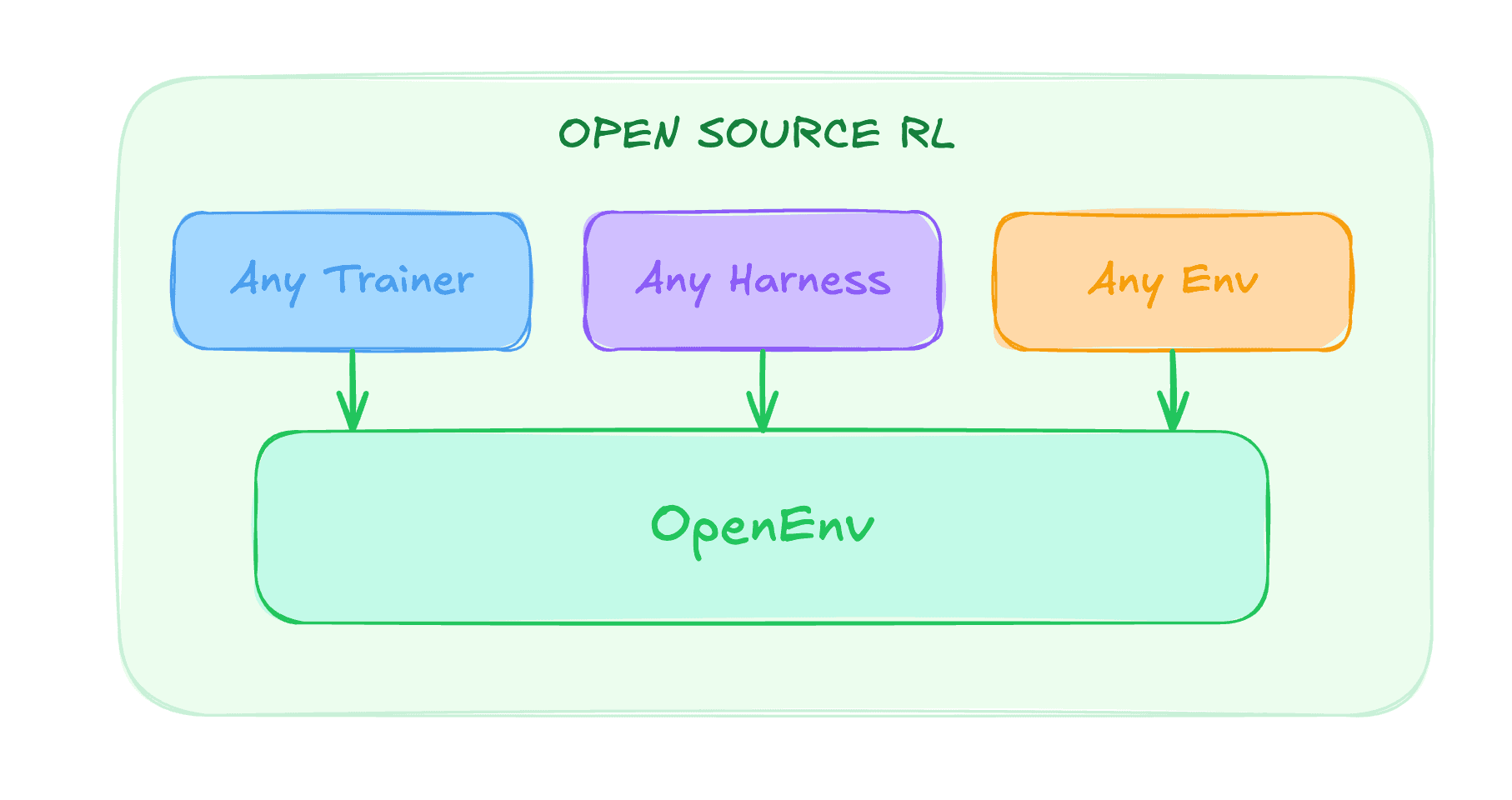
OpenEnv, a tool for building agentic execution environments, is transitioning to community governance with a steering committee that includes Meta, Nvidia, Hugging Face, and others. The project is being repositioned as a protocol layer for standardizing how RL environments are published and consumed by agents, rather than dictating reward frameworks or training logic. This move aims to enable open source models to achieve the same training efficiency that frontier labs achieve by co-optimizing models with their execution harnesses.

2 days ago· Hugging Face Blog